
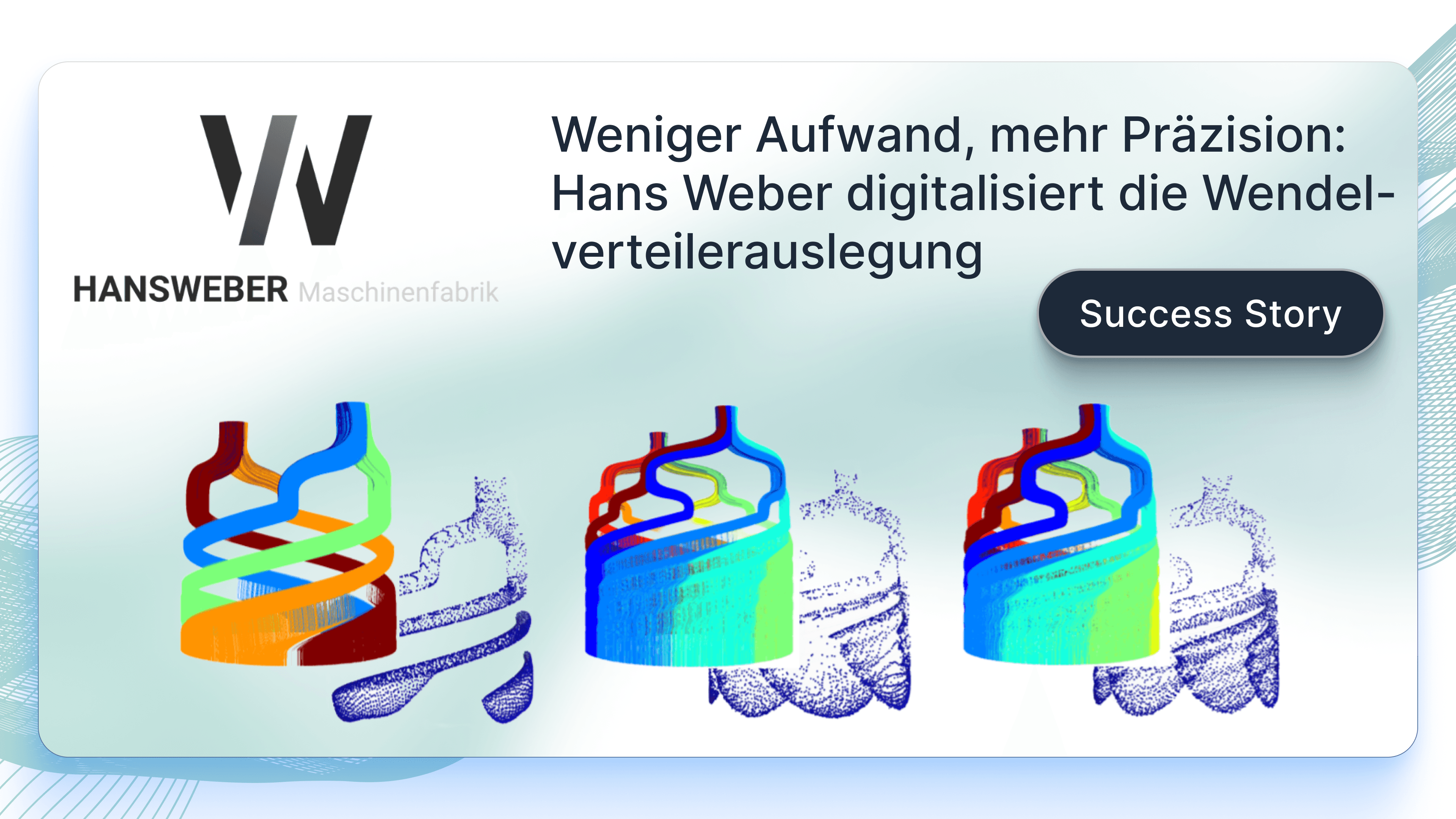
Less effort, more precision: Hans Weber digitizes the design of coil distributors
Significantly faster tool development and measurable cost advantages through parametric simulation and digital design of spiral distributors.
HansWeber
Hans Weber Maschinenfabrik optimizes its extrusion processes with the AI-powered StrömungsRaum® simulation by IANUS, achieving significantly faster development cycles and measurably higher design quality of spiral distributors.
Solution
By utilizing the StrömungsRaum® platform, Hans Weber was able to optimize the design of helical manifolds, reduce development times, and significantly enhance efficiency in tool design.
Company size
500 employees
Revenue
>83 million EUR
Challenge
Hans Weber Maschinenfabrik GmbH is facing increasing complexity in the design of its spiral distributors: a wide range of applications, varying polymers, and rising energy-efficiency requirements demand an ever more specific and precise design. At the same time, outdated tools and limited computing capacity make it difficult to run time-intensive simulations especially for short-notice inquiries or demanding materials.
Result
With the growing demand for energy-efficient, material-specific, and high-precision tools, Hans Weber faces new challenges in the design of complex spiral distributor systems. In particular, the precise distribution of melt flow, short purging times, the avoidance of dead zones, and optimal pressure behavior must all be taken into account—tasks that are not only time-consuming when performed manually, but also difficult to solve efficiently with outdated software.
“Thanks to intelligent parameterization combined with fully automated pre- and post-processing, complex simulations can be significantly accelerated. As a result, meaningful results are available not after days, but within just a few hours. This efficiency not only saves time, but also enables significantly faster decision-making in the development process.” - Development Management Extrusion, Hans Weber Maschinenfabrik GmbH
Process
With StrömungsRaum® from IANUS Simulation, Hans Weber is able to overcome these challenges through automated, parametric design. The cloud-based solution enables rapid adaptation of existing tools and fast development of new geometries—without local compute load or labor-intensive manual modeling. This also allows rare use cases to be simulated and compared efficiently.
StrömungsRaum® enables fully automated CFD simulations for helical distributor design—highly detailed and operable without specialized simulation expertise. By connecting to high-performance computing systems, the solution scales flexibly and delivers reliable results for design and development in minimal time.
Significantly shortened development time: By using parametric models, design and simulation time is reduced significantly—variant analyses and optimizations are completed within a few hours instead of several days.
Improved tool quality through precise design: Simulation-driven optimization results in more uniform distribution, reduced pressure losses, and minimized dead zones—essential for high-quality helical distributors.
Scalability and resource efficiency: Thanks to cloud computing, local compute resources are eliminated, increasing capacity for parallel simulations while reducing energy and infrastructure costs.
Standardization of complex processes: Through parametric modeling, helical distributor design is systematized and made reproducible—an essential advantage for series production and quality assurance.
Measurable added value for design and development: Simulations performed in advance provide solid metrics on pressure losses, flushing behavior, and overlap—technical decisions can be made faster and based on facts.
Conclusion
By automating the simulation with StrömungsRaum®, Hans Weber can respond parametrically to a wide range of spiral mandrel distributor geometries—without tying up additional development resources. Even complex variants can be calculated automatically in a short time, providing reliable results within just a few hours. The geometry is not designed manually; instead, it is defined using a small number of key parameters and generated automatically. This allows numerous variants to be simulated in parallel—for data-driven decision-making as early as the initial development phases.
Parametrized. Automated. Simulated—results in hours, not days. By entering customer-specific geometry parameters, the relevant geometry sections are configured automatically and assembled into a complete geometry. Manufacturability is taken into account. The complete geometry is then automatically meshed by our intelligent mesher and transferred into the simulation.
This function enables different geometry variants to be generated parametrically and the simulation results to be compared in a short time. This variant study gives us a deeper understanding of the effects of geometry changes and enables us to quickly identify an optimum. This significantly accelerates the concept phase and therefore shortens the time-to-market phase as well.
Through the parametric automation of spiral mandrel distributor design, Hans Weber can rapidly analyze numerous geometry variants and optimize them in a targeted manner for a wide range of materials and requirements.
This flexibility enables not only a more precise design with significantly shorter development times, but also a sound assessment of pressure losses, distribution quality, and flushing behavior—without additional design effort. In this way, Hans Weber positions itself as a pioneer of efficient, future-ready extrusion solutions.

"We save a significant amount of laboratory work, which is tedious, time-consuming, and requires a lot of personnel. It is so user-friendly that even non-engineers can operate the StrömungsRaum®."
"The introduction of automation into our simulation processes through IANUS's expertise has brought significant advantages for both us and our customers."
"With the partner package, we can quickly execute spontaneous simulations of coil distributors. We simply send the tool geometry and the process point; the rest is handled by IANUS itself. This saves us valuable resources."
Jesus Puente
Engineering Manager BBM